


Quick answer
The European Commission’s November–December 2025 sweep screened 314 traders. At least 30% did not meet EU price reduction rules, another 30% needed more information, and 40% fully complied. A separate 2022 sweep found roughly one in four announcements inconsistent among products that advertised a reduction. That is a product-announcement rate; the same 2022 sweep found violations on at least 43% of screened websites.
European Commission, Consumer Protection Cooperation sweeps · CCPC and European authorities, Black Friday and Cyber Monday pricing sweep
Key findings and sources
2025 pricing status across all screened traders
In the European Commission and national authorities’ November–December 2025 sweep of 314 online traders, at least 30% did not comply with price reduction rules, 30% needed more information, and 40% fully complied. These are screening outcomes for selected traders.
European Commission, Consumer Protection Cooperation sweeps · CCPC and European authorities, Black Friday and Cyber Monday pricing sweep
2022 Black Friday product and site denominators
In the 2022 European Black Friday sweep, 13 national authorities monitored roughly 16,000 products on 176 websites. About half displayed a reduction; roughly one in four of those announcements was inconsistent. At least 43% of websites had violations. The website and announcement percentages have different denominators.
European Commission, Consumer Protection Cooperation sweeps
Reference price changed the apparent discount
In one case published in the European Commission’s 2022 Black Friday sweep, a €23.99 sale price was labeled roughly 40% off using €39.99 as the reference. The regulator identified €27.99 as the applicable prior price, making the reduction roughly 14%. This is one observed price-history example.
European Commission, Consumer Protection Cooperation sweeps
Dark pattern counts in retail sites
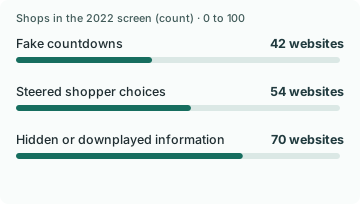
In a separate 2022 European sweep of 399 retail shops, authorities identified 148 with at least one of the three screened dark pattern categories. They reported 42 shops with fake countdowns, 54 steering choices and 70 hiding or downplaying information. Category counts can overlap.
European Commission, Consumer Protection Cooperation sweeps
Optional additions and the consent denominator
In the European pricing sweep of 314 traders conducted in November–December 2025, the CCPC reported that 36% attempted to add optional items, and four in ten within that subgroup lacked a clear request for consent. Multiplying the rounded shares gives approximately 14.4% of the screened group, without an exact count.
CCPC and European authorities, Black Friday and Cyber Monday pricing sweep
Determinate pricing cases use a narrower base
In the European Commission’s 314-trader pricing sweep, rounded status shares were 30% not meeting the requirements, 30% requiring more information and 40% fully compliant. Among cases with a determinate status, the arithmetic implies about 42.86% did not meet the requirements; the full-sample reported share remains 30%.
European Commission, Consumer Protection Cooperation sweeps
A different price reference changes the actual saving
In a worked pricing example, a final £80 price is £20 below £100 and £10 below £90. The second comparison yields 11.11% off. The eligible reference price must be established for the actual offer.
CCPC and European authorities, Black Friday and Cyber Monday pricing sweep
The two European screening categories cannot be added as an observed rate
Using the European Commission’s rounded 30% incorrect-discount-reference share and 36% optional-item-attempt share, the feasible share in either category ranges from about 36% to 66%. The publication reports marginal shares rather than their joint count.
314 traders in the Black Friday and Cyber Monday screening reported in March 2026. Bound the union by the larger share below and the sum of the shares above.
The maximum possible overlap was about 30% of screened traders
The same reported margins allow an overlap from zero to about 30% of screened traders. The larger possible overlap is limited by the smaller of the two published categories.
Same selected-trader sweep and rounded category margins. The overlap is at most the smaller share and at least the sum minus 100%, bounded at zero.
Compare the results
Three screening outcomes matter more than one headline
The Commission’s summary splits the 314 traders into at least 30% with a detected price reduction issue, 30% requiring more information and 40% that fully complied. The middle group matters. A pricing record that cannot establish the comparison price should stay unresolved until someone can check it. Counting unresolved traders as compliant understates the gap. Counting them as violations overstates what the sweep established.
Use the same distinction in a promotion audit. Mark a product, offer and market combination as verified, contradictory or missing evidence. For a disputed claim, store the historical record alongside the live checkout price and the precise copy a shopper saw. If the market, offer eligibility or reference-price history changes, recheck the claim before it appears in a message. Record enough detail that another person can repeat the decision without guessing which product version was inspected.
The same 2022 sweep produced two very different percentages
In 2022 authorities monitored roughly 16,000 products across 176 websites. About half of the monitored products advertised a Black Friday reduction, and roughly one in four of those announcements was inconsistent. Multiplying the two rounded shares implies approximately 12.5% of all monitored products had an inconsistent announcement. Separately, at least 43% of screened websites had a violation. A single inconsistent product can flag a website, so the two figures tell different stories.
A category manager can use product-level incidence to locate repeated pricing or catalog issues. A compliance lead needs the store-level result because one message template can repeat one mistake across many shoppers. Record both rates using a fixed sample rule. Comparing the 2022 site rate of at least 43% with the 2025 trader result of at least 30% cannot establish a trend. The sweeps sampled different units and used different screening designs.
A mathematically correct discount can still use the wrong price
In one published 2022 case, the sale price was €23.99. Against the advertised €39.99 reference, the arithmetic yields roughly 40%. Against the documented €27.99 prior price used by the regulator, it yields roughly 14%. The difference arises entirely from the reference price. In another published case the shopper paid €21.66 on Black Friday after the product had been €19.48. The price went up by about 11%, even though the label presented a 24% discount using a different reference.
For example, if a recovery email inherits a struck-through price from a product feed, check the underlying price history before reusing the percentage in the subject line. An advertised sale percentage can survive a product feed update while the reference, country or variant has changed. Preserve the source value and the date it applies to, instead of relying on a copied promotional label as evidence.
Test the offer in the customer’s actual checkout
The 2022 dark-patterns sweep looked at a separate set of 399 retail shops. Authorities reported 42 with fake countdown timers, 54 steering choices through design or copy, and 70 hiding or downplaying important information. The categories can overlap, and 148 shops displayed at least one of the three patterns. This is a practical shortlist of points to check alongside pricing records.
Give the audit a concrete scenario. Open the recovery link for an eligible shopper and for an ineligible shopper. Inspect when mandatory costs appear, whether an optional item can be declined, and whether the stated deadline survives a refresh. Check a real timer at the end of its window. If it expires as promised and the price returns to the normal value, log the verified result. If the timer resets without a genuine offer change, the remedy is to repair the claim or remove it from that path.
Separate the scope of an optional extra from the way it enters the basket
Authorities screened 314 traders and reported that 36% attempted to add optional items to shoppers’ baskets. Four in ten of that subgroup did so without clearly requesting consent. Multiplying the rounded percentages puts this at approximately 14.4% of the screened group. It does not recover the exact trader count and it does not estimate prevalence across the wider market.
The report also says that 18% used pressure techniques and more than half of those cases were assessed as misleading. Applying exactly half to the rounded 18% gives an illustrative 9% benchmark. The precise full-sample share cannot be recovered from the published wording. Review the claims separately in a checkout test: which extras require an affirmative choice, where the reference price comes from, and which inventory or deadline data support urgency language. Distinct issues can overlap in one checkout, so the percentages cannot be added.
How unresolved cases change the denominator
The 2025 sweep reported three groups for pricing rule compliance: about 30% did not meet the requirements, another 30% required more information, and 40% met them. Among cases with a determinate status, the reported shares imply approximately 42.86% in the noncompliant category. That comes from dividing 30 by 70. It does not replace the reported 30% of the full screened sample.
Combining the unresolved category with confirmed noncompliance answers a different question. It yields about 60% of the full screen that were either noncompliant or still needed evidence, 1.5 times the fully compliant share. Some unresolved traders may turn out to comply. Keep the evidence queue and the observed violations separate when citing the study.
A merchant reviewing its own catalogue can make the distinction operational. Keep one row per checked offer with the market, product, period, displayed price, applicable reference and supporting record. A confirmed mismatch is an issue to correct. Missing price history is a record to retrieve before the offer can be classified. Report the checked total and the count in each status so a colleague can see whether an improvement came from resolving missing records or fixing displayed prices. With a fresh sale, run the same checks again because both the price and the reference history can have changed.
Read the offer like a customer who changed one thing
A storefront can show a plausible crossed-out price and a different final discount after the customer selects a size, changes the quantity or adds a second item. These are ordinary paths. Test the exact basket and customer conditions that the offer describes.
For example, £80 is £20 below a £100 displayed comparison price. If the eligible reference for the chosen variant and customer was £90, the difference is £10, or 11.11%. This example compares two possible inputs. It does not determine which price qualifies under a specific rule or law.
Store the reference price, the eligible variant and the active offer together in the evidence for each promotion. Then run the same basket in the product page, cart, checkout and recovery message. Where the price depends on membership or a minimum quantity, say so before the customer has to test the checkout for themselves.
The screening results describe several kinds of risk with an unknown overlap
The European Commission reported that 30% of the 314 screened traders referenced discounts incorrectly and 36% attempted to add optional items. Those were categories in one screening. The published figures cannot tell us how often the same trader appeared in both. Under the rounded shares, between roughly 36% and 66% could have fallen into at least one category. The bottom of the range assumes every trader in the smaller category also appeared in the larger one. The top assumes the two groups did not overlap.
That range is more useful than a single sum if a merchant is planning a review of the checkout. It shows why a healthy reference-price check gives no assurance about add-ons. It also prevents calling 66% the observed result. The study screened selected sites during a sales event, so the figures cannot stand in for prevalence among all merchants.
Check the discount and the basket as two independent customer promises
Start from an eligible product and record the actual reference, discount and final price. Then add that product to the basket from a fresh session. Review the final cost, including each optional item. For any extra, confirm the customer’s selection and the price when the item is introduced. If eligibility changes with quantity or membership, run the same check at the minimum and immediately below it.
A missing joint count is a reminder to give each promise its own test, with a third test where both can change at once. A shopper who changes size after adding an optional service may lose eligibility for the price they saw while the service remains in the basket. Record the state at each step and compare the total in the recovery reply with the amount the customer can actually pay.
The denominator changes midway through the finding
Thirty-four percent refers to all traders screened. Six in ten refers to the smaller group that displayed a comparison. Write the two clauses together when citing the result. Treating six in ten as a percentage of the full sample makes the claim much larger than the source supports.
The same distinction applies to optional items and pressure selling. Thirty-six percent attempted to add optional items, and four in ten of that group did so without clearly requesting consent. Eighteen percent used pressure-selling tactics, and the authorities identified misleading conduct in more than half of those cases. The behaviors can overlap, so the overall percentages cannot be added to count distinct traders.
Run a price claim through checkout before the campaign
Open the product in the target market, choose the advertised variant and go far enough to see the actual amount payable. Record the current price, currency, comparison basis, eligibility rule and expiration. Repeat in a cart that fails one condition. A price claim that only works under a certain threshold or for a specific selection needs that condition where the shopper can use it.
If the checkout gives a different total, first check which line changed. Automatic discounts, shipping and promo codes belong in separate fields. A message can explain a verified condition or direct the buyer to a corrected checkout. It should not invent a code or promise a discount the shopper cannot reproduce.
When the right recovery reply is a correction
Imagine a shopper returns to a cart after a sale and asks why the price changed. Check the offer the buyer actually saw, the clock and the current cart. If the promotion ended, explain the time clearly and quote the amount the checkout actually supports. If the advertised price is still active but the cart is wrong, send the case to the team that can fix it.
The sweep makes unclear price claims worth investigating. The evidence that matters for your store is a consistent record of what was advertised and what was charged, supported by the people who own the offer and its rules.
Study data
| Measure | Value | Context |
|---|---|---|
| Incorrect discount references | 30% | Reported among traders screened |
| Attempted to add optional items to baskets | 36% | Reported among traders screened |
| Displayed price comparisons | 34% | Reported among traders screened |
| Used pressure-selling techniques | 18% | Reported among traders screened |
| Added extra fees late in checkout | 10% | Reported among traders screened |
| Measure | Value | Context |
|---|---|---|
| Advertised discounts in the Black Friday period | 94% | Traders that advertised discounts. |
| Price reduction rules fully met | 40% | Confirmed compliance in the sweep. |
| More information needed on price reductions | 30% | Unresolved at screening. |
| Unexplained reference among comparison-price traders | 60% | Commission describes this as six in ten, not six in ten of all traders. |
| Websites monitored in 2022 Black Friday sweep | 176 websites | Price monitoring sample. |
| Products monitored in 2022 Black Friday sweep | 16,000 products | Price records analyzed by authorities. |
| Monitored products advertising a reduction in 2022 | 50% | Approximately half advertised a Black Friday reduction. |
| Inconsistent 2022 announcements among products with a reduction | 25% | Approximately one in four announcements. |
| Websites with a detected 2022 Black Friday violation | 43% | The Commission reports at least 43%. |
| Shops with one or more screened patterns | 148 websites | At least one of three patterns. |
| Shops using fake countdown timers | 42 websites | Countdowns that were misleading in the assessed context. |
| Shops steering shoppers through design or language | 54 websites | Examples included unwanted subscriptions or higher-priced options. |
| Shops hiding or downplaying important information | 70 websites | Examples included important cost and availability information. |
| Measure | Value | Context |
|---|---|---|
| Unclear consent among traders trying to add optional basket items | 40% | The source reports four in ten within this subgroup |
What changes when you compare the figures
| Comparison | Result | Calculation |
|---|---|---|
| Approximate share of the full sweep with unexplained price comparisons | 20.4% | = 34 × 0.60 |
| Approximate share of all monitored products with an inconsistent reduction announcement | 12.5% | = 50 * 25 / 100 |
| Dark patterns screening share from published counts | 37.09% | = 148 / 399 * 100 |
| False sale percentage against advertised €39.99 reference | 40.01% | = (39.99 - 23.99) / 39.99 * 100 |
| Sale percentage against the documented €27.99 prior price | 14.29% | = (27.99 - 23.99) / 27.99 * 100 |
| Actual increase in the disguised-price-rise example | 11.19% | = (21.66 - 19.48) / 19.48 * 100 |
| Approximate share of all screened traders adding extras without clear consent | 14.4% | = 36 * 40 / 100 |
| Illustrative threshold using half of the pressure-selling share | 9% | = 18 * 50 / 100 |
| Share judged incorrect among cases with a determinate status | 42.86 % of determinate cases | = 30 / (30 + 40) * 100 |
| Cases with an issue or unresolved status relative to fully compliant cases | 1.5 times | = (30 + 30) / 40 |
| Worked case, the checkout total is £80 with a £100 reference | 20 GBP | = 100 - 80 |
| Worked case, saving versus the actual £90 eligible price | 10 GBP | = 90 - 80 |
| Worked case, percent off the £90 price | 11.11% | = (90 - 80) / 90 * 100 |
| Minimum possible share in either of the two sweep categories | 36% | = 36 |
| Maximum possible share in either category | 66% | = 30 + 36 |
| Maximum possible overlap between the categories | 30% | = 30 |
Methodology and sources
We used Ireland’s CCPC release, issued by a participating authority. It reports separate whole-sample and conditional results. Its six-in-ten comparison figure applies to the 34% that displayed price comparisons. Multiplying the rounded figures gives about 20% of the full sample, an approximation rather than an official count. The sweep targeted online traders and does not estimate prevalence across all ecommerce stores.
We separate the November–December 2025 price sweep from the 2022 Black Friday price-monitoring and 2022 dark-patterns exercises. Each is an authority-led screen of selected sellers rather than a probability sample. The result for comparisons uses the merchants that actually displayed a price comparison, and the 2022 announcement result uses the products advertising a reduction. We keep approximations and minimums as published. Any recomputed share or discount is marked as arithmetic using the rounded published values or the Commission’s two illustrated price histories. The work does not combine counts between sweeps or add overlapping dark-pattern categories.
Download the source data (CSV)
Download the calculations (CSV)
Related reading
Shopping cart coupon statistics from Alibaba’s randomized promotion study
Equal-Value Checkout Promotions Can Get Different Responses
Countdown timer statistics and how to verify an ecommerce offer
Check the real price before you promise two Shopify discounts
Sources and definitions
CCPC, European sweep of Black Friday and Cyber Monday pricing practices
European Commission, Consumer Protection Cooperation sweeps
The source data includes the population, period, denominator and limitations for every figure.